Elis Giromini
Ontwikkelt een kritische VR-vertelling over migratie waarin de ervaringen van migrantenvrouwen zorgvuldig en van binnenuit centraal staan.
Opleiding: Master in Creative Writing.
What happens to a body that transforms while crossing borders?
Held is an artistic research project investigating matrescence — the term coined by anthropologist Dana Raphael in 1973 to name the profound transformation into motherhood — as a form of radical shapeshifting. A metamorphosis as radical as adolescence, yet almost entirely absent from cultural representation, collective ritual, and medical language. The matrescent body reorganizes itself at a cellular level, grows another being from within, loses the coherence of a singular self. In WEIRD (Western, Educated, Industrialized, Rich, Democratic) societies, it undergoes this transformation largely alone: without ceremony, without communal witnessing, without structures to hold what cannot be held individually.
For migrant and refugee mothers, this invisibility compounds. To undergo matrescence while crossing geographical, legal, and linguistic borders simultaneously is a double shapeshifting: the corporeal transformation of pregnancy compounded by displacement, foreign healthcare systems navigated in foreign languages, the absence of family networks and cultural frameworks that might otherwise provide meaning. Drawing on Gloria Anzaldúa's theorization of border-crossers as those who inhabit contradiction and refuse fixed categories, and engaging with Julia Kristeva's abjection theory, Silvia Federici's analysis of reproductive violence, and Dorothy Roberts's documentation of racialized maternal oppression, this research positions the matrescent migrant body as the shapeshifter incarnate — refusing boundaries, exceeding categories, producing life while containing death.
The research unfolds across three interconnected works: the novel Mother, Stranger, which follows a pregnant Italian woman displaced to post-Brexit England through a narrative voice that fractures between first and third person to stage dissociation on the page; the performance The Shape of Love, which makes public what WEIRD culture demands remain private — the ambivalence, the rage, the obstetric violence that new mothers are expected to absorb in silence and then forget; and the installation Held.
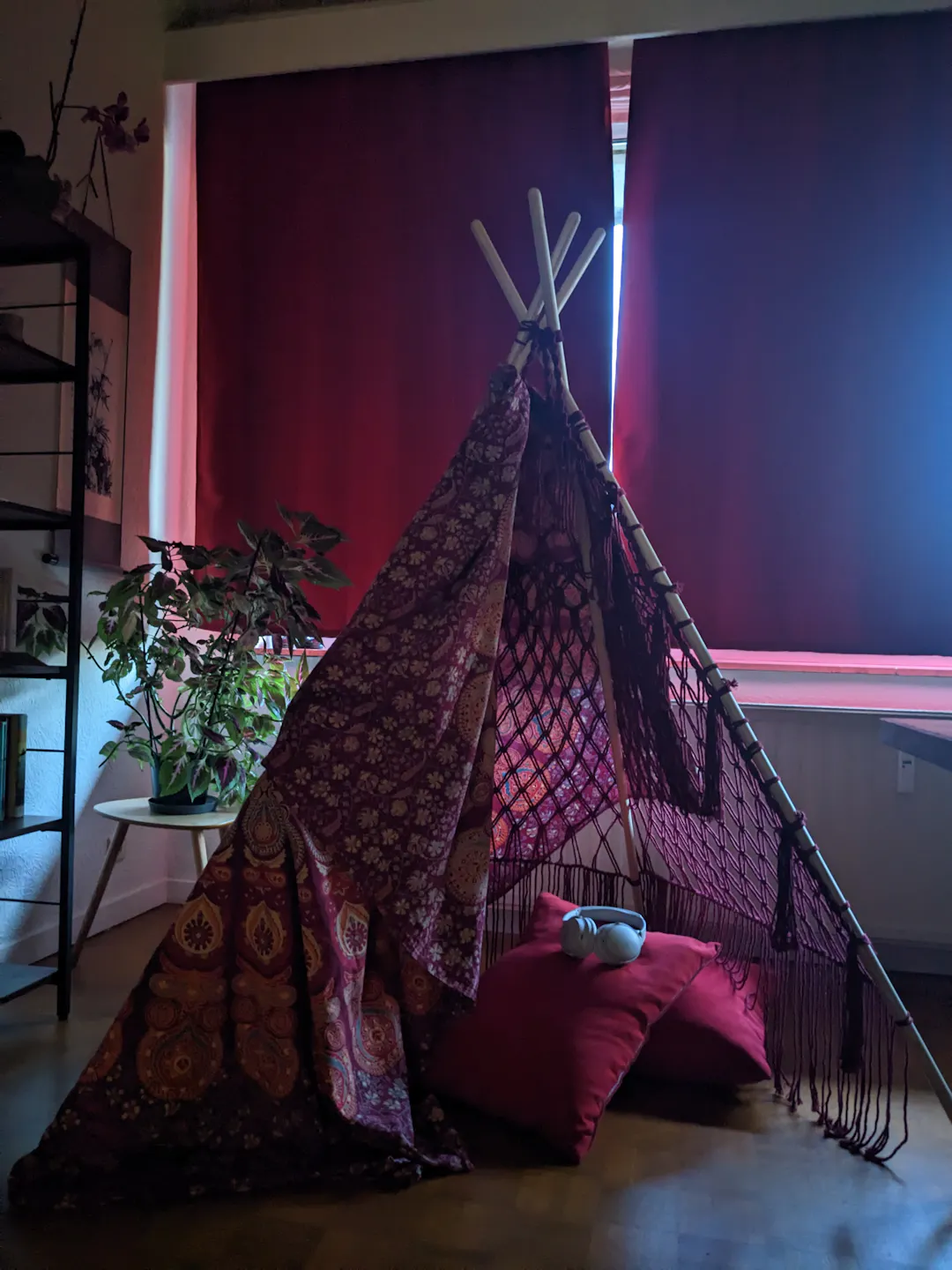
Enter the red tent and you enter a body: the first border any of us has ever crossed. The red tent is an ancient symbol — a space apart, a threshold between states of being where women gathered during menstruation and birth across many pre-modern cultures. Here it becomes a womb-space and a proposition: what might it feel like to be collectively held during transformation, rather than left to shapeshift alone?
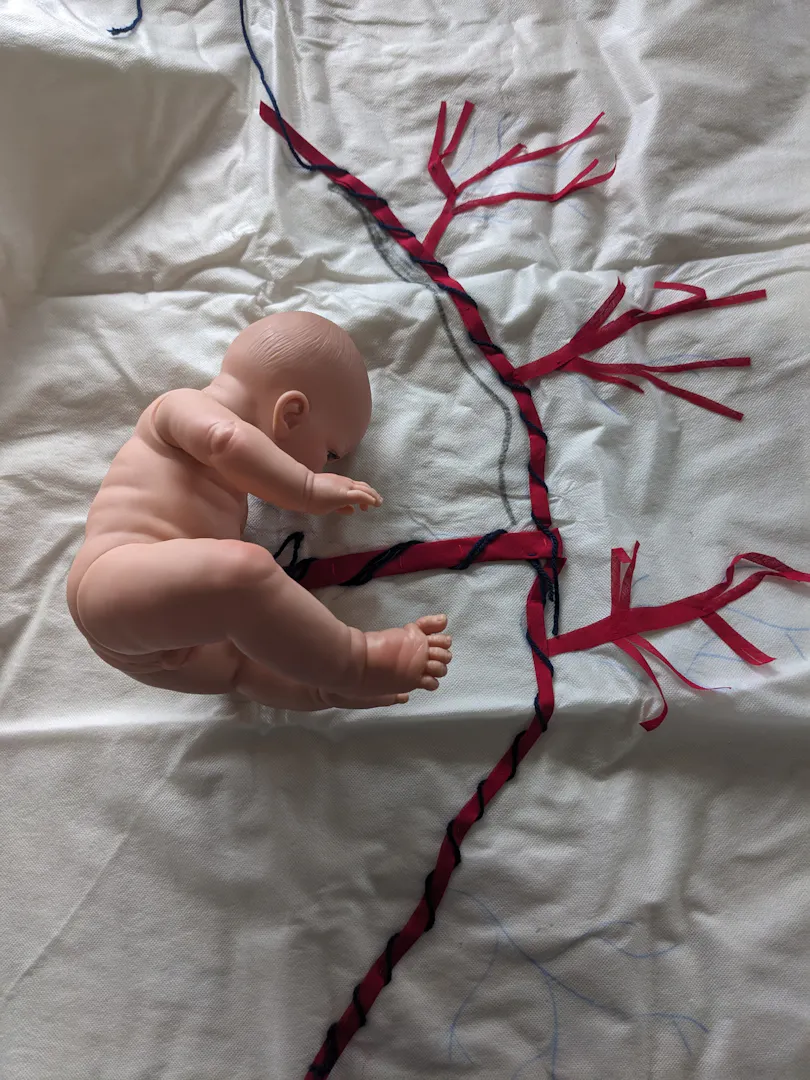
Inside, textile fragments trace the shapes of gestation — a uterus, a body curled inside another body. These are not diagrams but remnants: the material memory of a body that refuses to resolve into coherence. The soundscape layers the text of The Shape of Love, filling the red interior with the words that should not be spoken, the ambivalence that has no public language. A video made through shadow theatre projects a pregnant silhouette onto the walls: present and elusive, body and border at once.
The installation is also a prototype. In October 2026, this research will extend into participatory workshops with migrant and refugee women — women whose experiences of matrescence are among the most invisibilised by the very systems that should support them. The workshops will invite participants to create together through textile work, sound, writing, and movement. The red tent will become a shared structure, built collectively rather than entered alone — a shift from singular authorial voice to multiple voices, from representation to co-creation.
Held insists that matrescence is not one experience but many, shaped by race, class, legal status, language, and access to care. This is art as rehearsal, and as question: how do we shapeshift together rather than alone?